Lusaka | June 15, 2026 – As financial criminals increasingly exploit technology, virtual assets and complex cross-border transactions to conceal illicit wealth, Zambia is taking steps to ensure its investigators remain ahead of the curve.
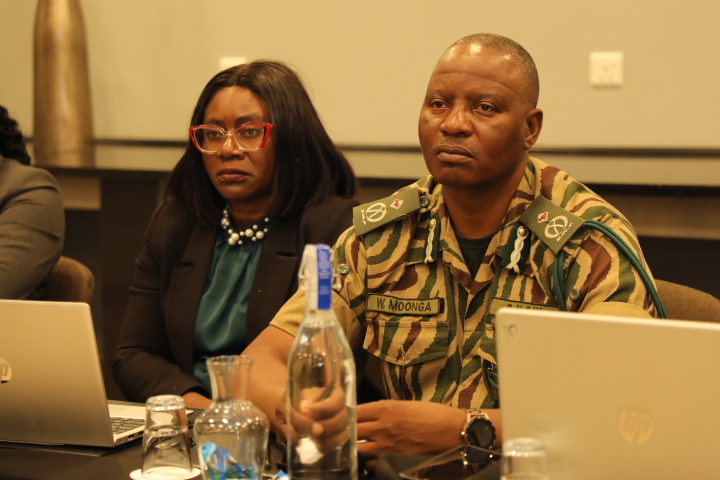
Experts from law enforcement and regulatory institutions have convened in Lusaka for a strategic retreat to develop specialised training modules for the National Curriculum on Financial Investigations and Asset Recovery, a key initiative aimed at strengthening the country’s response to financial crime, illicit financial flows and asset recovery.
The retreat was officially opened by the Learned Director of Public Prosecutions, Mr. Gilbert A. Phiri, SC. Also delivering opening remarks were Mr. Samuel Eduam representing SecFin Africa, the European Union-supported programme assisting Zambia’s anti-money laundering and asset recovery efforts and Acting Director-General of the Financial Intelligence Centre, Mr. Brian Kauzeni.
The initiative builds on a major milestone reached in January 2024 when all 21 member institutions of Zambia’s Inter-Agency Coordination and Cooperation Framework formally adopted the National Curriculum on Financial Investigations and Asset Recovery.
Developed with support from the former EU-ESCAY Project, the curriculum was designed to establish a common national standard for training investigators, prosecutors, regulators and other practitioners involved in combating financial crime.
The curriculum was developed to address a long-standing challenge faced by many jurisdictions of ensuring that investigators, prosecutors, regulators and other practitioners charged with combating financial crime operate from a common foundation of knowledge, skills and professional standards.
This week’s retreat marks the next stage of that journey.
Participants have been tasked with developing the practical training modules that will transform the curriculum from a framework on paper into a working tool capable of shaping the next generation of financial investigators across Zambia.
Opening the retreat, the learned DPP observed that financial crime is becoming increasingly sophisticated, driven by rapid technological change and the emergence of new methods of concealing criminal proceeds. He stressed the need for investigators to acquire specialised skills capable of matching these evolving threats.
He further urged participants to ensure that the modules adequately address emerging challenges involving virtual assets and digital financial systems, which are increasingly being exploited to conceal, transfer and launder proceeds of crime.
Once completed, the modules will form part of a standardised national training framework aimed at strengthening investigative capacity, enhancing inter-agency cooperation and improving Zambia’s ability to detect, investigate and recover proceeds of crime.
The retreat brings together experts from institutions represented within the Inter-Agency Coordination and Cooperation Framework and represents another important step in Zambia’s ongoing efforts to build a more coordinated, skilled and effective response to financial crime.
In an era where financial crime is increasingly sophisticated, borderless and technology-driven, Zambia’s response is evolving too one investigator, one institution and one training module at a time.