
Lusaka | September, 2026 – Crime is no longer cash in a suitcase. It is a wallet you cannot touch, a transaction that crosses three borders in seconds, wealth hidden behind layers of code and corporate fronts.
And last week in Lusaka, Zambia decided to meet it head on.
Investigators, prosecutors and financial regulators were locked in for five days, from September 14 to 18, not for another talk shop, but to write. To review. To argue over every word of what will become Zambia’s standard for how financial crime is investigated and how stolen assets are recovered.
This workshop is the second draft. Literally.
In June, experts from across the Inter-Agency Coordination and Cooperation Framework retreated to build the first set of specialised training modules for the National Curriculum on Financial Investigations and Asset Recovery. In August, that draft was put through a validation process, interrogated by the very people who will use it.
Last week, the drafters returned with the marked-up version.
Around the table are independent subject experts from the National Prosecution Authority, the Bank of Zambia, the Drug Enforcement Commission, the Financial Intelligence Centre and the Anti-Corruption Commission, conducting a peer-to-peer review that is as technical as it is critical. Each module was tested for one thing: will it work when an investigator is faced with a real case involving virtual assets, digital laundering or complex cross-border flows?
The work builds on a foundation laid in January 2024, when all 21 member institutions of the Inter-Agency Framework formally adopted the National Curriculum. Developed with support from SecFin Africa, the European Union-supported programme, the curriculum was meant to solve a problem every jurisdiction knows too well: investigators, prosecutors and regulators trained in silos, speaking different professional languages while chasing the same criminal networks.
The curriculum gave Zambia a common language. This workshop will give it the textbooks.
When he opened the initial retreat in June, the Learned Director of Public Prosecutions, Mr. Gilbert A. Phiri, SC, had warned that financial crime has mutated. Technology has made it faster, virtual assets have made it harder to trace, and sophistication has made it harder to prove. His charge to the experts then still defines their work now: build modules that are alive to emerging threats.
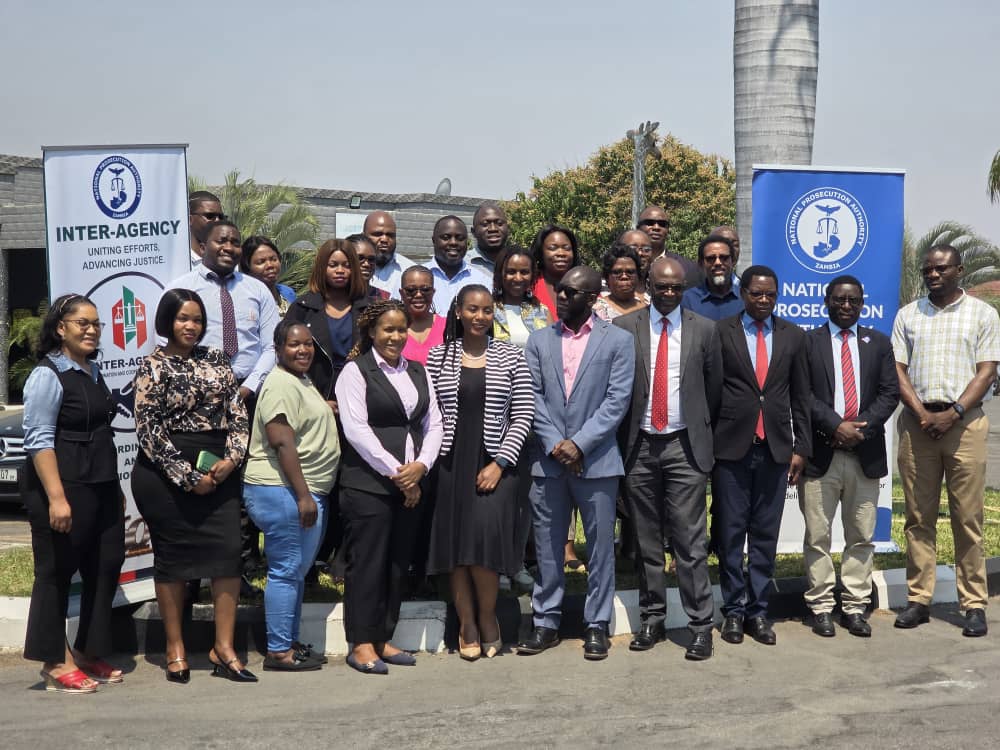
He was joined by Mr. Samuel Eduam, representing SecFin Africa, and Financial Intelligence Centre Director General Mr. Brian Kauzeni, who both underscored that asset recovery is no longer a niche skill. It is central to fighting corruption and illicit financial flows.
Once finalised, these learning tools will not sit on a shelf. They will become the national standard, the manual through which every financial investigator in Zambia is trained, regardless of institution.
In an age where criminals collaborate across borders and platforms, Zambia is doing the same, one institution, one expert, one training module at a time.